|
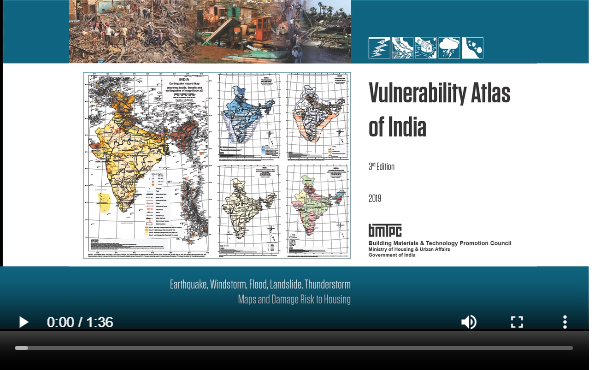
It is a basic e-learning course that offers awareness and understanding about natural hazards, helps identify regions with high vulnerability with respect to various hazards (earthquakes, cyclones, landslides, floods, etc.) and specifies district-wise level of damage risks to the existing housing stock.
The e-course will be a tool for effective & efficient disaster mitigation & management in the field of Architecture, Civil Engineering, Urban & Regional Planning, Housing & Infrastructure Planning, Construction Engineering & Management and Building & Materials Research. The e-course on Vulnerability Atlas of India has been launched as one of the activities under “Construction Technology Year (2019-20)” which was announced by the Hon’ble Prime Minister during Construction Technology India 2019: Expo-cum-Conference under Global Housing Technology Challenge – India on 2nd March, 2019 at New Delhi. It will be offered jointly by the School of Planning & Architecture, New Delhi and Building Materials & Technology Promotion Council (BMTPC), Ministry of Housing & Urban Affairs.
|
 |
The aim of the e-Learning Course is to raise the level of awareness and preparedness as well as to enhance skills and professional competencies of key stakeholders. The course is designed specifically to build capacities of:
- Individuals who wish to keep themselves abreast with knowledge about various hazards, vulnerability and disaster mitigation measures, in order to be better prepared.
- Students, faculty, practitioners and researchers of Urban and Regional Planning, Civil Engineering and Architecture colleges or other allied disciplines.
- Public and private professionals working in the housing and infrastructure sectors such as roads, rail, aviation and ports.
- Defence and Central Armed Police Forces involved in civil engineering projects.
- Officials of National and State Disaster Management Authorities.
- Central, State and Local Government officials.
- Members of consulting organisations.
- Members of civil society organisations.
Applicants can register and log on to the e-course from anywhere at any time. The course does not require any face-to-face discussion or physical appearance in the examination. The course is beneficial for those who are unable to attend physically or do not have sufficient time to attend training programmes. The e-course allows learners to progress at their own pace with no restriction on duration.
Multiple-choice question (MCQ) based self-assessments are provided after each module. Learners are encouraged to revisit modules and repeat assessments if required. A final MCQ-based examination is conducted at the end of the course. Applicants are allowed a maximum of three attempts. Upon successful completion, a self-generated digital certificate will be awarded.
Six contact programmes will be organised annually for applicants who successfully complete the e-course within one year. These will be conducted at SPA New Delhi and other designated incubation centres. Participants may choose a location based on their convenience. The Basic Course on Vulnerability Atlas of India is currently open to all individuals interested in acquiring knowledge on the subject. Advanced professional courses will be offered shortly to those who complete the basic course or possess relevant qualifications or experience.